Started

Amazingly I managed to get started today even though many things conspired against me.

I completed the discovery section of the One Pass Revision with little issue. I had pretty much done all that stuff before starting the story, and some of it even still applied. I worry that it may have been too easy. Maybe I did something wrong? We’ll see.

So I started the slog. I managed to be brutal. I hacked the entire first chapter right out of the book. It was a tough choice, but I think it was the right one. I’m holding on to it, because it could easily be expanded into a short story on it’s own, but the book doesn’t need it. Do I think the book is better without it? I’m not sure, but it’s not the solid start I want, so it had to go.

Chapter 2 Scene 1 didn’t need too much work. Chapter 2 Scene 2 wasn’t bad, but I rewrote most of it. Chapter 2 is light on dialog. Chapter 1 wasn’t. Since it’s gone, I needed to get some more dialog into the book earlier. This removed a bit of infodumping, and allowed me to improve some weak characterization.

Not a bad hour and half’s worth of work. Special thanks to the kids for letting me get it done.

Ready to Begin

Ok. I think I’m ready to start on the revisions. Let me just check the supply list

  • A printed copy of the manuscript. Check.
    Supplies: Manuscript
  • A cheap spiral-bound notebook. Check.
    Supplies: Notebook
  • A couple of smooth-writing pens. Check.
    Supplies: Pens
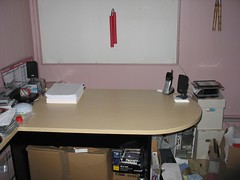
  • A table with room for three piles and an open notebook. Check (covered earlier).
  • Good lighting. Check.
  • Nerves of SteelTM. We’ll find out!

2YN: The Two-Year Novel Course, Year One

I feel compelled to recommend 2YN: The Two-Year Novel Course, Year One, by Lazette Gifford to anyone who has even considered writing a novel. I haven’t yet read the book, but I did take the class on which the book is based. In fact, I’m taking it again for my next novel.

The first year covers:
  • Writing Basics: Ideas, Genres, Themes, Conflict and more
  • Character development
  • Worldbuilding
  • Outlining
  • Writing, including what to do when you get stuck

Having gone through the process, and I can tell you that it works. Pick up a copy now. It is currently available as a downloadable PDF, so you can get started right away. What are you waiting for?


Rebooting the Edit Process

It’s time to get back to editing my first novel. I’m going to start over. I read lots of articles on editing when I started, and one of them really stuck out: Holly Lisle’s One-Pass Manuscript Revision. I recently re-read the article, and it makes a lot more sense now. Right from the opening it grabbed me and said, “Just start over and try this.”

The first draft of your novel is finished. Now, according to the recommendations of any number of writing books, pundits, and writers who go through this themselves, you’re in for five or ten or more rounds of revision, in which you’ll polish your work until it is a gleaming, perfect pearl … and in which process you’ll dither for months or years.

You can do that if you want. But you don’t have to.

I believed that when I read it the first time, but I didn’t have the confidence to try it. Instead I tried something which can only be called “my way.” I can tell you with great confidence that “my way” sucks big time. Maybe I needed to fail on my own before trusting someone else on this. Who knows.

So I need to start with the Supplies section, and the thing that sticks out right now is:

A table where you have room to stack your manuscript into three piles and have the spiral-bound notebook open at the same time.

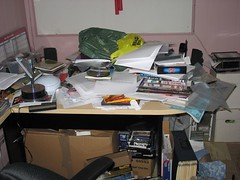
Yeah. I have that. It’s the rear section of my desk. Problem is it currently looks like this:

Supplies: The Desk

So that’ll be step one for me. Clean the desk!

Using a Mind Map to Organize Novel Notes

I downloaded Freemind to help organize my notes for the new novel. I’m really pleased with it. It’s easy to use, and really lets me get my thoughts down. I’m impressed with how easy it is to navigate around.

Here’s what my notes so far look like fully expanded:
BWC Notes Mind Map
You can’t really make them out, but there are little arrows connecting the nodes.

Still Writing

I haven’t been posting much, and I haven’t mentioned writing in a while, so here’s a quick update. The novel edit is on hold right now. I need to rethink my approach. There are some problems, and I have a good feeling what they are, but I’m not sure how to fix them yet. Every time I’m sitting still for 10 seconds to think about it someone gives me something to do. So I’m working on other writing related tasks. I’m doing world-building work for another novel, and I’m writing some short stories set in that world to help flesh some things out.

E-Mail Miscommunication: Blaming the Medium

Warning: Potential grumpy old man rant ahead.

I saw this article today on slashdot all about how e-mail communication leads to misunderstanding. It’s an old argument I’ve heard before, and while I’ve seen it in action a number of times, I still don’t buy it.

One of the arguments most often touted is that e-mail has no “tone of voice”. This is true, but neither does any form of written word. None of the novels I’ve read have a tone of voice either (excluding audiobooks), but if the writing is clear, it’s a non-issue. The article discusses a lack of facial expressions in email. What? Even if that were true (which it is not, actually), I fail to see the relevance. Write clear, and you will not be misunderstood. On the other side of that coin, don’t read things into an e-mail that are not clearly there. If it seems ambiguous, whatever you think it means is probably wrong.

You really can’t blame the medium for the message. People today generally have poor written communication skills. Writing an email should be no different that writing a letter. The last actual letter I recived from a friend is still tacked up on my desk. It’s well written, clear, concise, and in a style quite similar the longer e-mails she sends. The quick, one liner e-mails are a different matter. We all send them. Sometimes they are unclear. When they are, the best thing to do is to ask for clarifacation, not go off and assume the sender is attacking you.

Sure, I had a few bad experiences at first with e-mail. I said some things that were widely misunderstood. I got involved in battles that didn’t need to exist. Everyone does this, but there is no reason for it to happen more than a few times. I learned to save a draft, move on to something else, and reread the e-mail later. If anything seemed ambiguous I would fix it before sending. I don’t still do this, but I did learn a lot of lessons about the types of mistakes I was likely to make. I’m more likely to avoid those now. I just assume everyone will misunderstand everything I say, and I rewrite to try to make that more difficult.

People need to take the time and reread what they wrote. If it’s worth saying, it’s worth saying clearly. It’s really not that hard. If rewriting for clarity is something that you do have an issue with, learn to love the emoticon, it might save a friendship or two. Remember, you have no idea how long the person on the other end will keep that e-mail for. That right there should be enough to make you think before you click send.

Perhaps the real problem is more to do with a misplaced sense of entitlement. Many people who have e-mail take it for granted. The fact that you can communicate with anyone in the world almost instantly holds no sense of wonder anymore. I saw it happen. I may have missed the start of Eternal September, but watched the downward spiral and knew where it was heading fairly early on. The medium is not the issue, it’s how it’s (ab)used.
Congratulations Dave Sim

Dave Sim was inducted into The Joe Shuster Canadian Comic Book Creator Hall of Fame on Saturday. After his acceptance speech he sung an a capella version of all three verses of “My Way”.


brief clip courtesy The Beat.

His introduction was given by J. Michael Straczynski, who in a recent interview had the following to say about Dave:

When he first started out, the idea of telling one story of that magnitude and that duration, over a period of over 20 years, without a publisher behind you, is insane. But he believed he could do it. Even though reason said you can’t do it, his faith said ‘I can’. And, by gosh, he did.

The funny thing is, that’s how society changes. There’s those of us that just want to get along in the world and we try to blend in with and fit into the world around us. And there’re those who either believe in themselves a great deal or are insane who say ‘No, no, I will change the world to match me’. And those are the one’s who do change the world.

Dave Sim changed the world of comics because of what he did with Cerebus.

What Dave did with Cerebus has always been an inspiration to me. Because of him, and others like him, I always took it as a given that self published comics were a viable choice. Even today when the market is flooded with titles I think it can still be done, at least if it’s approached in an intelligent manner. Sure the facts seem to say otherwise. Independent books have quite a struggle today. There was a brief boom in the mid to late eighties, but that’s long past now.

But part of me still believes that there is still a market out there for well told stories. I’ve dipped in and out of comics for the past few years, and the market seems to be flooded with garbage. I don’t think this is just grumpy-old-man-syndrome on my part, because the stuff I see today is the stuff I hated in the early 90s. While the market may never turn around, at some point i think it will become viable again for new independent works.

Without Dave Sim, I would believe none of this. When all the other books I followed disappeared from the shelves Cerebus continued to show up, mostly on time, for it’s entire 300 issue run. That’s pretty damn impressive, and it shows what can be done by two guys (Gerhard really deserves some more public recognition, which should be obvious because I only mentioned him once) who commit to something.